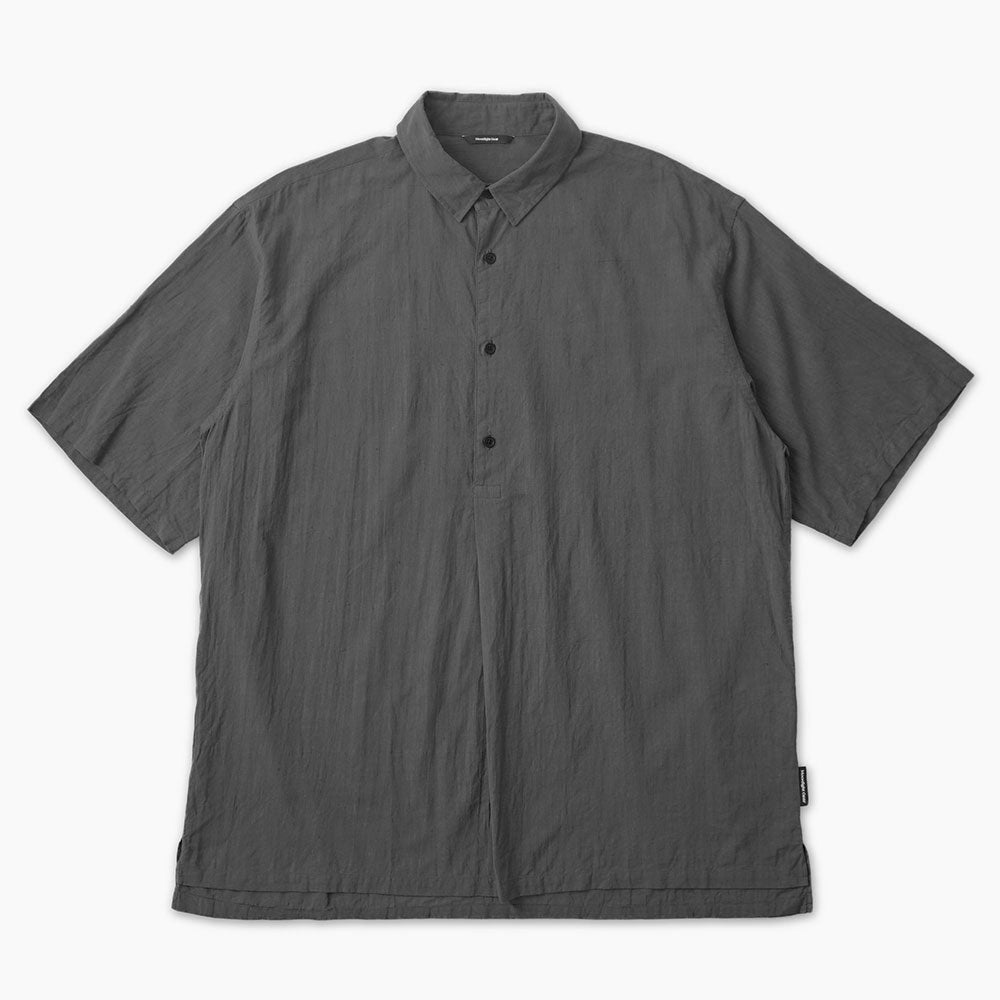
Root Shirt S/S
Root Shirt S/S
Size Guide
Size Guide
Size |
Length |
Width |
Sleeve Length |
Weight |
|---|---|---|---|---|
S |
74(76)cm |
55cm |
51.5cm |
85g |
M |
77(79)cm |
58cm |
53cm |
90g |
L |
80(82)cm |
61cm |
54.5cm |
95g |
XL |
83(85)cm |
64cm |
56cm |
100g |
※Length is measured from the center of the back. The number in parentheses indicates the measurement from the side neck point to the hem.
※Weight may vary by about 10g depending on color or individual item.
Couldn't load pickup availability

More comfortable. Cooler. A gentler way through Japan's humid summer.
The Root Shirt S/S is made from Khadi, a hand-spun and hand-woven cotton from India. Soft, breathable, and kind to the skin.
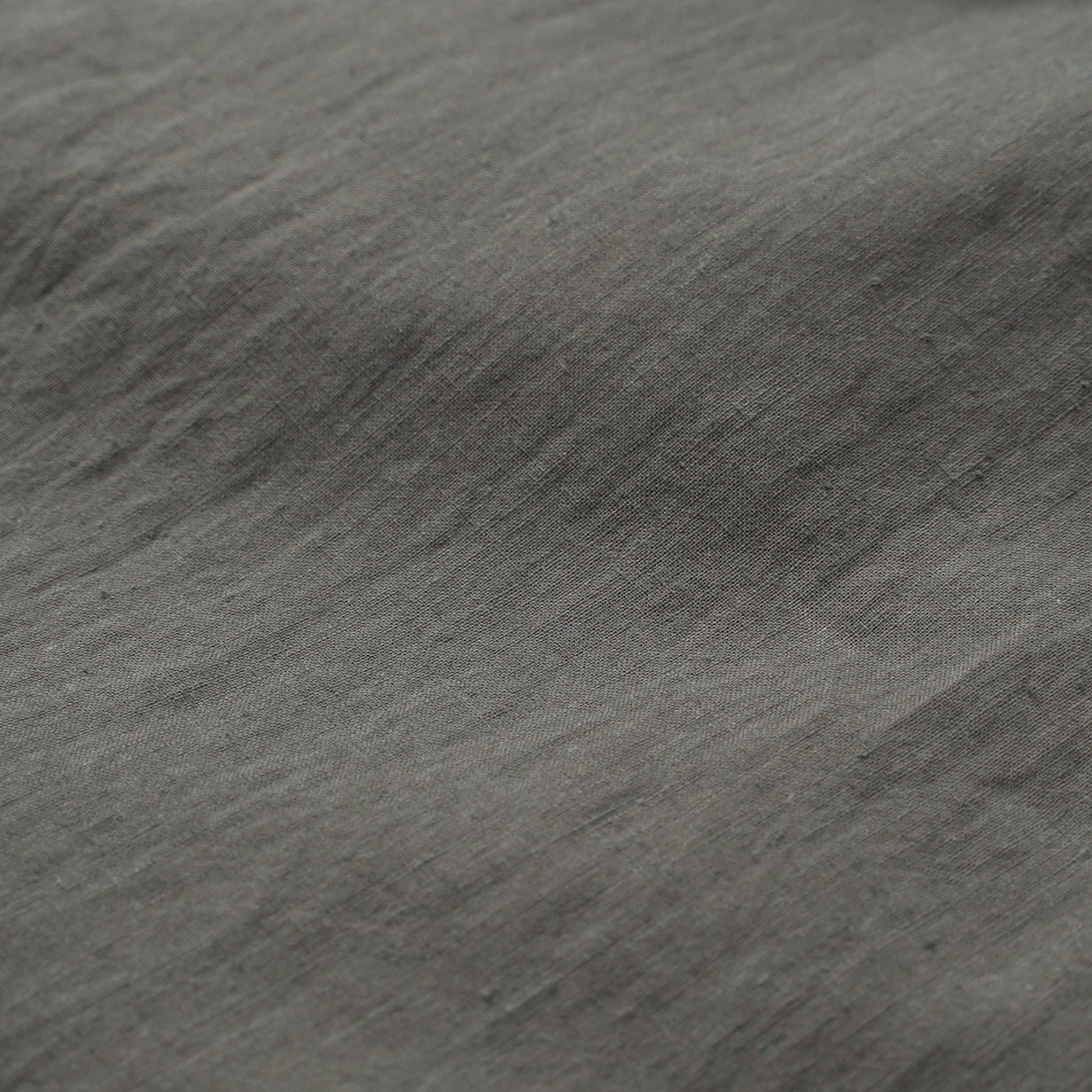
Unlike machine-spun yarn, hand-spun threads are naturally uneven, creating subtle variations in the weave that give this cotton remarkable moisture absorption and quick-drying properties you wouldn’t expect from cotton.
Despite being made from natural fibers, it weighs a mere 90g in size M.
For daily wear, hiking, or travel — a lightness so complete, you'll forget you're wearing anything at all.
Made with India's traditional hand-spun and hand-woven fabric, Khadi.
Khadi, made by artisans through hand-spinning and hand-weaving in India.
The history of Khadi is ancient. It’s a traditional craft with references found in texts dating back over 3,000 years.
Unlike machine-spun yarn, hand-spun threads are naturally uneven, creating subtle variations in the weave that give this cotton remarkable moisture absorption and quick-drying properties you wouldn’t expect from cotton.
The hand-spun yarn, so soft it can't be woven by machine, feels as gentle as gauze, and offers a comfort that grows increasingly familiar against the skin with every wash.
Compared to typical cotton, it's remarkably thin, so it dries quickly even after sweating, and the cooling effect of evaporation helps regulate body temperature.
Woven in India, then piece-dyed at a Japanese dye house — improving colorfastness and reducing shrinkage in the wash.
Balancing the character of Khadi cotton with refined tailoring.
The Khadi cotton is sewn at one of Japan's leading shirt factories.
Hand-spun, hand-woven Khadi is an exceptionally soft and delicate material. Due to the difficulty of working with it, few factories can sew it with precision.
Using the fine-count thread typical of dress shirts and a high level of craftsmanship, each stitch is sewn with care, giving the garment a clean, refined finish.
Precisely because this fabric carries the simple, handmade quality of a craft object, we chose to tailor it with the discipline of Japanese shirtmaking.
The aim wasn't to create something that reads as something borrowed, but a piece that belongs equally in everyday life and in the outdoors.
A lightweight, thin, and breezy pullover style.
Tucks are added below the placket, creating a natural flare toward the hem and a distinctive, draped box silhouette.
To protect the skin from the sun, the sleeves are slightly longer. The cuffs are cut wide, letting the wind pass through for a light, breezy feel.
Updated for the 26SS season with a more generous fit for better airflow and a cooler, more comfortable feel.
-
Model height: 174cm, weight: 58kg, wearing size M, Charcoal
-
Model height: 164cm, wearing size M, Moss Gray
-
Model height: 174cm, weight: 58kg, wearing size M, Charcoal
-
Model height: 172cm, weight: 62kg, wearing size L, Moss Gray
-
COLUMN
Khadi, a traditional Indian textile.
Thread spun by hand, woven by hand on a manual loom.
Said plainly, it sounds simple. But since the Industrial Revolution, the making of yarn and fabric has evolved in pursuit of greater efficiency, uniformity, and consistency.
Khadi, meanwhile, is still made in India today by the old methods.
The one who spins the thread. The one who weaves the cloth. The one who dyes it.
Work divided among a village, passed hand to hand between people living close to one another, until, slowly, it becomes a single piece of fabric.Because every step is done by hand, the yarn is never perfectly uniform. The twist remains gentle, and subtle variations naturally emerge in the density of the cloth.
By the standards of mass-produced fabric, this reads as inconsistency and a material that resists control.
But it's exactly that inconsistency that gives Khadi its comfort.
Differences in thread thickness and twist create fine irregularities across the surface. Because the weave isn't packed too tight, air moves through it. The fabric stays soft and full, resisting the urge to cling to skin.
And more than anything, because it has a thin, lightweight finish, it dries faster than you'd expect from cotton.
By its nature, Khadi doesn't lend itself well to mass production. Quality is hard to keep consistent, and shrinking or fading come easily.
Even so, we were drawn to how this material feels to wear.
We began wondering if we could hold on to that comfort while making it something people could reach for more freely — from everyday life to the outdoors.
For this piece, we had undyed Khadi woven in India, then brought the fabric to Japan for high-temperature dyeing.
Khadi dyed by hand in India carries a beauty that only hand-dyeing can give — but it also tends to run into problems with colorfastness and shrinkage.
Dyeing at high temperature lets the pigment set more firmly. At the same time, it tightens the loosely woven fabric just slightly, making it less prone to losing its shape or shrinkage through wear and washing.
If we only thought about effort or cost, it would be simpler to finish every step in India.
But what we wanted to make wasn't just a shirt that happened to use a traditional fabric.
It was something that kept the softness, the airiness, the lightness that Khadi from India carries — while becoming a piece anyone could wear without hesitation, from everyday life to the outdoors.
To do that, we brought together traditional Indian craftsmanship and Japanese dyeing technology.
Fabric spun by hand, woven by hand, uneven by nature — refined with just enough modern technique to give it greater stability.
This shirt is, in that sense, a piece born where the traditions and techniques of two places meet.
writing / Daiki Nozawa
spec
Material
- 100% Cotton
Colors
- Moss Gray
- Charcoal
Country / Region of Production
- Japan — Aomori Prefecture
Updates
- Overall sizing increased slightly
- Fabric now dyed in Japan, reducing color fading and shrinkage
Attention
There may be weaving irregularities, thread pulls, nep (small knots), or color inconsistencies in the fabric. Please understand this as a characteristic of the handmade production process and the nature of the fibers used in the country of origin.